Are Dental Implants Worth It? What Patients Should Consider

Quick answer: For most patients replacing a single tooth, yes, though the reason is not the one usually given. An implant costs more upfront than a bridge and roughly the same over a lifetime, so the case for it rests on what it does not require: it does not involve filing down two healthy neighboring teeth, and it is the only option that keeps the jawbone under the gap stimulated. Implants are not the right answer for everyone, and the situations where they are not worth it are specific and worth knowing before you spend anything.
Dr. Christopher Chin, MPH, DMD, is a Fellow of the International Congress of Oral Implantologists and a Fellow of the Academy of General Dentistry, a distinction held by roughly 6% of general dentists in the United States and Canada. This guide is written the way we discuss it in the chair at Casas Adobes Dentistry in Tucson, including the parts that argue against treatment.
In This Guide
- The cost comparison people actually need
- What you are really paying for
- When implants are not worth it
- The maintenance nobody mentions
- Survival is not the same as success
- How the timeline actually runs
- Single tooth, several teeth, or a full arch
- What doing nothing costs
- Questions worth asking first
- Paying for it
- Find out if you are a candidate
- Dental implant FAQs

The cost comparison people actually need
Comparing sticker prices is what makes implants look expensive. Comparing cost per year of service, and counting what each option does to the teeth around it, changes the picture.
| Option for one missing tooth | Typical range | What it costs you over time |
|---|---|---|
| Single implant with crown | Roughly $3,000 to $5,500 all in | Often decades of service; the crown may need replacing before the implant does |
| Three-unit bridge | Roughly $2,500 to $4,500 | Commonly replaced every 10 to 15 years, and two healthy teeth are permanently altered |
| Removable partial denture | Lowest upfront | Relines and replacements, plus daily removal and ongoing bone loss at the site |
| No replacement | Nothing today | Drifting neighbors, a supra-erupting opposing tooth, and bone loss that raises the cost of every future option |
Run your own numbers rather than accepting either side's framing. A 45-year-old choosing a bridge may be re-crowning those two anchor teeth two or three more times before turning 80, and each of those cycles carries its own risk of the anchor tooth needing a root canal or failing outright. That is the part the upfront comparison hides.
What you are really paying for
Three things, in order of how much they matter over a lifetime.
Keeping your other teeth intact
A traditional bridge requires removing healthy enamel from the teeth on either side of the gap so they can carry crowns. Those teeth are permanently changed. They will need crowns from that point forward, whether or not the bridge itself survives. An implant stands on its own and leaves the neighbors alone.
Bone preservation
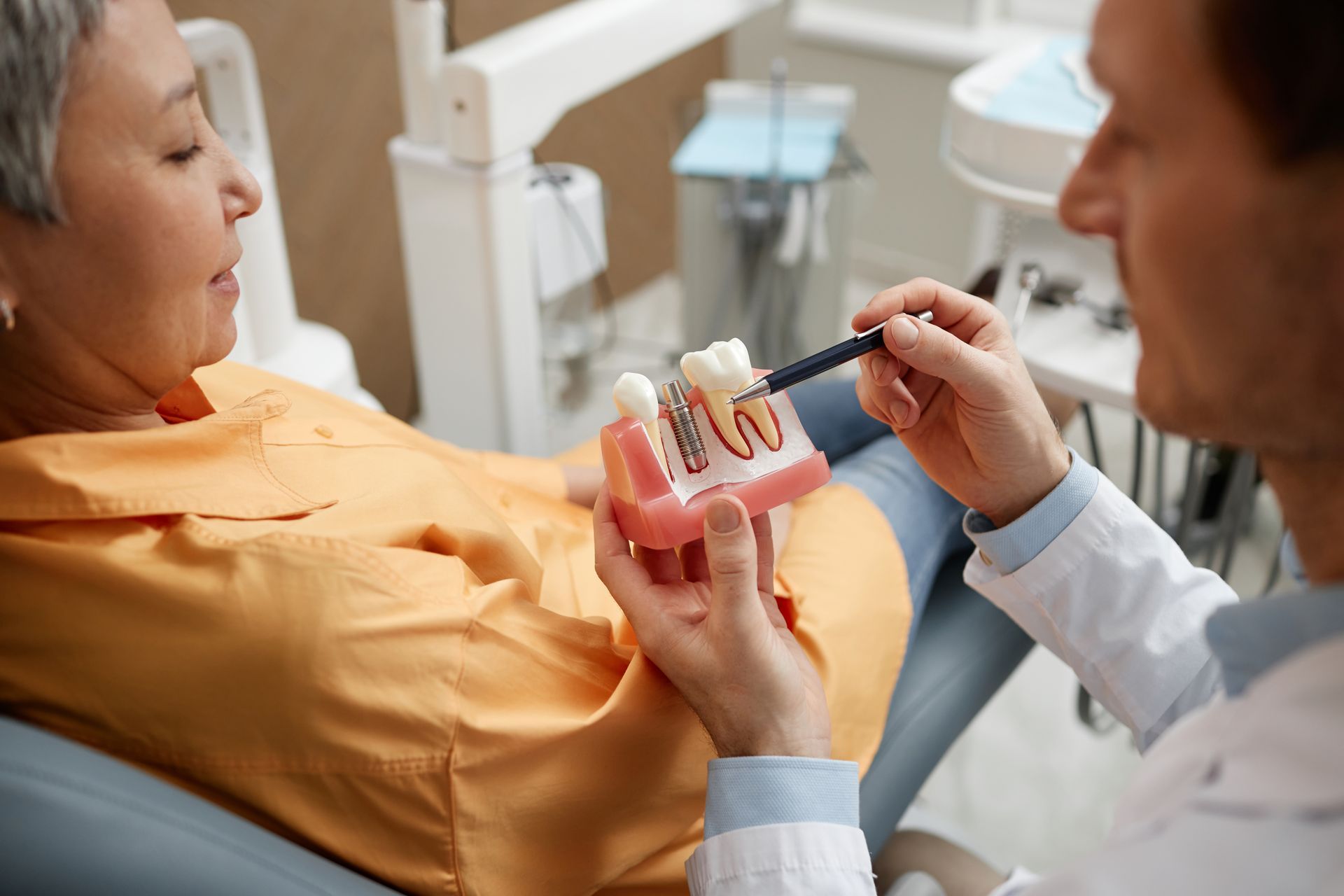
A natural tooth root transmits chewing forces into the jawbone, and that stimulation is what tells the bone to maintain itself. Remove the root and the bone at that site gradually resorbs. A bridge spans the gap but does nothing for the bone underneath it. An implant is placed into the bone and functions like a root, which slows that loss considerably.
This is not purely cosmetic. Progressive bone loss affects the stability of neighboring teeth, changes facial contours over years, and makes any future treatment at that site more complex and more expensive. If you already have loss at the site, that is what a bone graft before a dental implant addresses.
Function that does not change how you eat
Implants transmit chewing force the way teeth do. Patients who have worn a partial denture usually describe the difference in terms of what they stopped avoiding.
When implants are not worth it
We talk patients out of implants often enough that it is worth listing when.
- The adjacent teeth already need crowns. If both neighbors have large failing fillings and are heading for crowns anyway, a bridge accomplishes two goals at once and the implant's main structural advantage disappears.
- Uncontrolled gum disease. Implants are not immune to the bacteria that cause periodontal disease. Placing one into an unmanaged mouth sets up a failure.
- Heavy grinding without a plan for it. Bruxism loads an implant in ways it tolerates poorly, and implants lack the ligament that cushions a natural tooth. A night guard is part of the treatment, not an add-on.
- Active smoking. It meaningfully raises failure risk by impairing healing. We discuss this openly rather than as a disqualifier, and we cover it in can smokers get dental implants.
- Poorly controlled diabetes or certain medications. Healing capacity drives implant success. Antiresorptive medications for osteoporosis require a specific conversation before surgery. See can diabetics get dental implants.
- A back molar with no functional consequence. Occasionally the right answer is that the gap does not need filling at all.
- A timeline that does not fit. Implants take months, not weeks. If a wedding is in six weeks, the sequence matters more than the choice.
The maintenance nobody mentions
Implants do not get cavities. That fact gets quoted constantly and leads people to assume implants are maintenance-free. They are not.
Peri-implantitis is inflammation and bone loss around an implant, driven by bacteria much as gum disease is around a natural tooth. It is the leading cause of late implant failure and it is largely preventable with cleanings and daily hygiene. It also tends to be painless in its early stages, which is exactly why it gets caught at checkups rather than at home.
The crown wears out before the implant does. The titanium post can serve for decades while the porcelain crown on top may need replacement somewhere in the 10 to 20 year range, particularly on a molar. Budget for that as a normal event.
Screws loosen. The abutment screw connecting crown to implant can loosen over time, which is typically a quick retightening rather than a crisis, but it means you will see your dentist about it.
Your hygiene routine changes slightly. Implants need specific cleaning around the margin, and hygienists use instruments that will not scratch the titanium surface.
Survival is not the same as success
You will see high survival rates quoted for implants, often around 95% at ten years. Those numbers are real and they are also narrower than they sound.
Survival means the implant is still in the mouth. Success means it is stable, the bone around it is healthy, the crown looks right, and the patient is comfortable. An implant can survive while losing bone, or while the crown next to it has an aesthetic problem at the gumline.
The practical takeaway is to ask a different question than "what is the failure rate." Ask what the plan is for keeping the bone around it healthy, how often it will be evaluated, and what happens if the crown needs replacing in fifteen years. Those answers tell you more about long-term value than any statistic.
How the timeline actually runs
Patients underestimate the calendar more often than the cost, so it helps to see the sequence laid out.
From extraction to placement
If the tooth is still in place, it comes out first, and in most cases we graft the socket at the same appointment to preserve bone volume. That site then heals for roughly three to four months before an implant goes in. Placing into a fresh socket is possible in selected cases and we will tell you when yours is one.
From placement to crown
After the implant is placed, osseointegration, meaning the fusion of bone to the titanium surface, typically takes three to six months depending on bone quality and whether grafting was involved. You are not toothless during that window; a temporary keeps the space looking normal.
Why the wait is the point
The months are not padding. They are what separates an implant that lasts decades from one that loosens in year two. Same-day marketing claims usually refer to same-day temporaries rather than a same-day final restoration, which is a distinction worth asking about directly.
Single tooth, multiple teeth, or a full arch
"Worth it" changes considerably with how many teeth are involved.
For one tooth, the comparison is the one above: implant versus bridge versus nothing, and the implant usually wins on preserving the neighbors.
For several teeth in a row, you do not necessarily need one implant per tooth. An implant-supported bridge uses two implants to carry three or more teeth, which often lands at a better cost per tooth than individual implants while keeping the bone stimulated at both ends.
For a full arch, the economics flip in favor of implants faster than people expect, because the alternative is a full denture with relines, adhesive, and ongoing bone loss that changes facial shape over years. Four to six implants can carry a fixed arch, which is what
All-on-4 refers to, and the comparison there is less about cost per tooth than about whether you want something that comes out at night.
What doing nothing costs
Leaving a gap is a decision with its own price tag, just deferred.
Teeth move. The teeth on either side of a gap tilt into it over time, and the tooth above or below it erupts further out of its socket looking for contact. That drift changes your bite, makes cleaning those tilted teeth harder, and can put the whole arch out of alignment. Bone at the site continues resorbing the entire time.
The consequence is that the gap gets more expensive to treat the longer it sits. A site that would have taken a straightforward implant at year one may need orthodontic uprighting of the neighbors and a bone graft at year six.
Questions worth asking before you commit
Implant quotes vary widely between offices, and the spread is usually scope rather than markup. These questions make two estimates comparable:
- What exactly is in the price? Surgical placement, the abutment, and the crown are three separate components. A quote covering only the first is not a quote for a finished tooth.
- Is imaging included, and what kind? A 3D scan shows bone volume and the position of nerves and sinuses. Planning from a flat X-ray alone is planning with less information.
- Will I need a graft, and is it in this number? Sometimes the answer is not known until placement, in which case ask what it would add.
- Which implant system is being used? Components from established manufacturers stay available for decades, which matters when a part needs replacing in year fifteen and you have moved to another state.
- Who is placing it and who is restoring it? Sometimes that is one office and sometimes two, and knowing up front prevents a gap in accountability.
- What is the warranty, and what voids it? Most warranties assume you keep your cleaning schedule.
Paying for it
Dental insurance coverage for implants varies widely. Many plans that historically excluded implants now cover a portion, often at the same tier as major restorative work, and most carry an annual maximum that will not cover the full treatment in one calendar year. Splitting treatment across two benefit years is a legitimate strategy when the clinical timeline allows it, since implant treatment already spans months.
Health savings and flexible spending accounts apply, and we offer
dental implant financing in Tucson. Our detailed breakdown of
dental implant costs in Tucson covers what goes into a quote and why estimates differ between offices.
Find out if you are a candidate
The only way to answer this for your mouth is an exam with imaging that shows the bone at the site. We will tell you what your options are, what each would cost, and which one we would choose if it were our tooth, including when that answer is a bridge.
Call Casas Adobes Dentistry at
(520) 365-0559 or
request a consult. You can read more on our
dental implants page, compare options in
dental bridge vs implant, or see
how long dental implants last.

Frequently Asked Questions
How long do dental implants last?
The implant itself commonly lasts decades and can last a lifetime with healthy bone and good hygiene. The crown attached to it is the shorter-lived component, often needing replacement somewhere in the 10 to 20 year range depending on position and bite forces.
Is an implant better than a bridge?
For a single missing tooth with healthy neighbors, usually yes, because it preserves those neighboring teeth and the bone. A bridge is often the better choice when the adjacent teeth already need crowns, when bone volume is inadequate and grafting is not wanted, or when a faster timeline matters.
Do dental implants hurt?
The surgery is done with local anesthesia, and sedation is available for patients who want it. Most people describe the recovery as more manageable than an extraction. We go into detail in do dental implants hurt.
How long does the whole process take?
Typically several months from placement to final crown, because the implant needs time to integrate with the bone. Cases requiring extraction, grafting, or sinus work run longer. Temporary options keep the space looking normal in the meantime.
What makes an implant fail?
The two leading causes are infection around the implant and inadequate healing at placement. Smoking, uncontrolled diabetes, unmanaged gum disease, and heavy grinding without a night guard all raise the risk, and all of them are things we evaluate before recommending treatment.
Share this Post
Casas Adobes Dentistry Blog